| Year | |
| Event | Doggerbank re-emergence |
| Location | |
| Aftermath | Hypothetical 'North Sea War' in early 1920s, with ongoing geopolitical effects in Northern Europe |
| New Land Exposed | Over 12,000 sq km |
| Surrounding Nations |
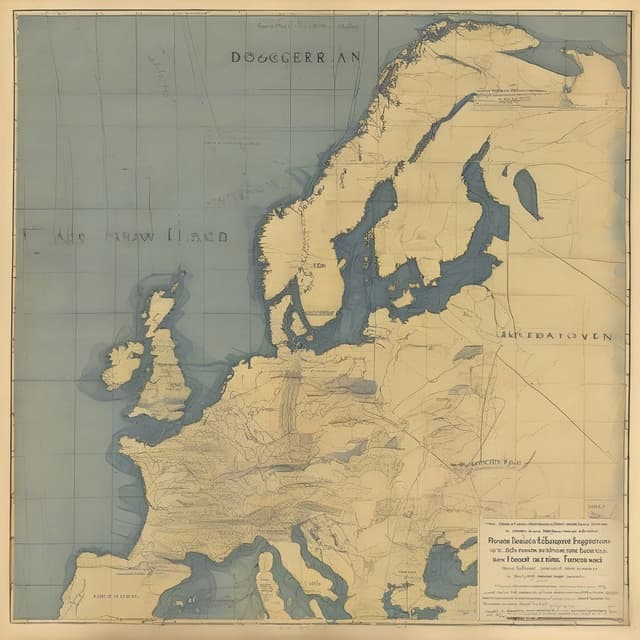
In the early months of 1919, a seismic event of global significance occurred in the North Sea. The Doggerbank, a large shallow underwater plateau located roughly equidistant between the coasts of the United Kingdom, Germany, Denmark, and the Netherlands, abruptly re-emerged from the seafloor, exposing over 12,000 square kilometers of new land mass. This dramatic geological change, unprecedented in recorded history, immediately sparked a heated international crisis as the surrounding nations scrambled to assert their claims over the newly emerged territory.
The Doggerbank had long existed as a large shallow area in the center of the North Sea, with water depths generally less than 50 meters. In the early 20th century, it was a well-known fishing ground and navigation hazard for ships, but was otherwise largely ignored by the coastal nations. However, on January 1, 1919, powerful seismic activity and undersea landslides caused the plateau to rapidly rise, breaching the surface of the sea.
The new Doggerbank landmass was a surprisingly fertile and resource-rich expanse, featuring arable soil, fresh water sources, and abundant mineral deposits including coal, oil, and precious metals. Situated in a highly strategic location at the heart of the North Sea, it also offered unparalleled naval and commercial control over the shipping lanes connecting the Baltic, the North Atlantic, and the English Channel.
The sudden appearance of this new territory set off an immediate scramble by the surrounding nations to lay claim to Doggerbank. The United Kingdom, seeing it as an extension of their North Sea territories, quickly dispatched naval and military forces to establish a presence. Likewise, the German Empire, still recovering from its World War I defeat, viewed Doggerbank as vital to its economic and military resurgence, and moved to occupy the eastern portions.
Meanwhile, the Kingdom of Denmark and the Netherlands also asserted their own historical rights and geographic proximity to various sections of the new landmass. Tense negotiations, military buildups, and occasional skirmishes along the Doggerbank perimeter ensued throughout 1919 and 1920 as the powers jockeyed for position.
The potential for all-out conflict between these major European powers was high, exacerbated by lingering resentments from World War I, competing nationalist claims, and the region's strategic significance. This volatile situation was a key factor in the outbreak of what became known as the "North Sea War" in 1921, a two-year-long military and diplomatic conflagration with far-reaching consequences.
Even after the North Sea War's resolution, the Doggerbank remained a source of ongoing tension and instability in Northern Europe. The division and administration of the territory was a central part of the post-war peace settlement, creating new borders, enclaves, and autonomous regions that continued to generate friction between the claimant states.
The rich natural resources of Doggerbank also became a point of contention, fueling an international competition for mineral rights, fishing grounds, and industrial development. This economic rivalry was a key factor in the formation of trading blocs and regional organizations that shaped the geopolitics of the interwar period.
Moreover, the dramatic ecological changes caused by the landmass's emergence had lasting impacts on the North Sea environment, disrupting fishing stocks, altering currents and storm patterns, and causing the loss of important marine habitats. These environmental consequences added an additional layer of complexity to the management and sovereignty disputes over Doggerbank in the decades that followed.
In the end, the 1919 re-emergence of the Doggerbank stood as a profound geopolitical and geostrategic event, one that reshaped the map of Northern Europe, catalyzed major regional conflicts, and left a lasting imprint on the politics, economics, and ecology of the North Sea basin. Its consequences would continue to echo through the 20th century and beyond.
